
Your Ultimate Guide to Winning at Flag Football
Think of American football—the incredible passes, the lightning-fast runs, the clever plays. Now, imagine all that high-octane action without the bone-jarring tackles. That’s flag football in a nutshell.
Instead of bringing a player to the ground, defenders snatch a flag from the ball carrier’s belt to end the play. It’s a simple but brilliant twist that makes the game safe, fast, and incredibly fun for everyone.
Unpacking the Global Rise of Flag Football
At its heart, flag football is all about skill, speed, and smarts. It keeps all the thrilling parts of traditional football—acrobatic catches, pinpoint throws, and crafty defensive plays—but gets rid of the heavy collisions. This shift from brute force to pure finesse is exactly why it’s catching on like wildfire.
The goal is still the same: get the ball down the field and score a touchdown. But without tackling or blocking, the how completely changes. Offense is all about sharp routes and a quarterback who can thread the needle. Defense becomes a game of quick feet and even quicker thinking. It’s as much a mental workout as a physical one.
A Sport for Everyone
One of the best things about flag football is that literally anyone can play. It’s become the go-to for youth leagues, giving kids a safe way to learn the game's fundamentals. You can learn more about the top benefits for young athletes joining a local team and see why so many parents are jumping on board.
And it’s not just for kids. Adult and coed leagues are popping up everywhere. They’re a perfect way for former players to stay in the game or for total newcomers to get active and join a community, all without the physical beating of tackle football.
A huge part of the sport's appeal is how easy it is to get started. You don't need a mountain of expensive pads and helmets. All it really takes is a football, a set of flags, and some good cleats.
From Local Parks to the Olympic Stage
This isn't just a trend you see at your neighborhood park; it’s a full-blown global movement. An estimated 20 million athletes are playing flag football across more than 100 countries. That massive number includes over 3.4 million kids around the world, creating a talent pipeline that’s helped push the sport to its official debut at the Los Angeles 2028 Olympic Games.
Governing bodies like the International Federation of American Football (IFAF) have worked tirelessly to get the sport recognized on the world’s biggest stage. This global embrace proves that flag football has grown far beyond a recreational hobby—it's now an elite, competitive sport with a seriously bright future.
Mastering the Field and Core Rules of the Game
To really play flag football well, you have to know the battlefield and its laws. This isn't just a game of raw speed and agility; it’s a chess match on grass, where every play is shaped by a specific set of rules. Getting these fundamentals down is your first real step toward becoming a smart, competitive player.
Think of a flag football field as a shorter, faster version of a traditional one. While the exact size can change from league to league, most are 70 to 80 yards long between the goal lines, plus two 10-yard end zones. This condensed space makes every yard critical and keeps the pace of the game lightning-fast.
This concept map breaks down the simple but brilliant structure of flag football, where the core rules lead directly to the main objective.
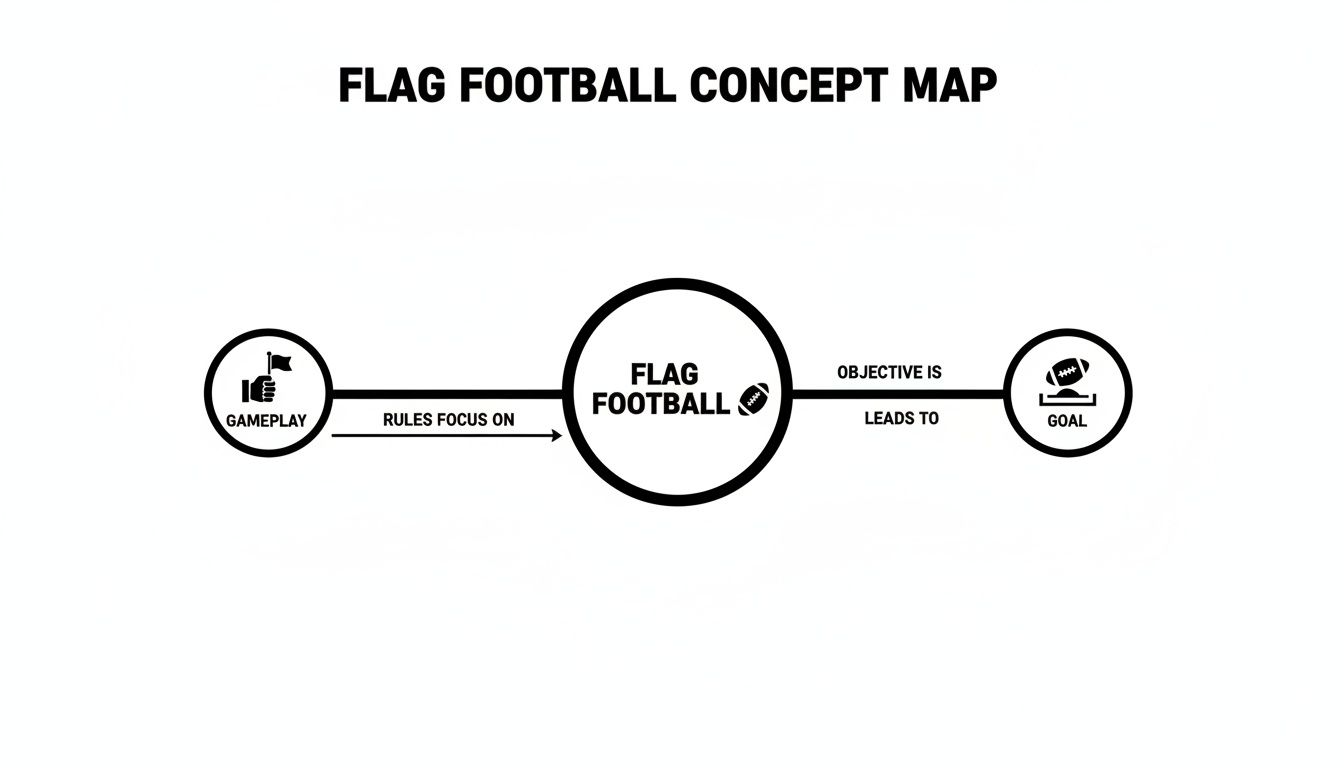
As you can see, the whole game is built around that one simple act: pulling a flag. By replacing the tackle, it opens up a world of strategic possibilities for getting into the end zone.
Understanding the Game Clock and Downs
A typical game is split into two halves, usually 20 to 25 minutes each. The clock generally keeps running, only stopping for things like timeouts or scores. When your team has the ball, you get a set number of "downs"—almost always four—to move the ball past a certain line, often midfield. If you make it, you earn a fresh set of downs and keep going.
But if you don't cross that line in four tries, the ball gets turned over to the other team right where you stand. This setup creates constant pressure to execute your plays and keep possession.
How a Play Begins and Ends
Every single play kicks off with a snap, where the center hikes the ball back to the quarterback. Once the QB has the ball, a timer starts. They often have just seven seconds to either throw it or hand it off for a run. This "pass clock" forces quick decisions and prevents the quarterback from scrambling around forever.
A play is over when one of a few things happens:
- Flag Pull: The most common ending. A defender snatches one of the flags off the ball carrier's belt.
- Touchdown: The ball carrier breaks the plane of the other team's goal line.
- Incomplete Pass: The pass hits the turf before a receiver can catch it.
- Out of Bounds: The person with the ball steps outside the field's boundaries.
The flag pull is the soul of the sport. It's a precise skill that replaces the brute force of a tackle. A clean, decisive pull requires timing, agility, and focus, making it a cornerstone of effective defense.
Key Rules and Common Penalties
While the rules are meant to be straightforward, a few are absolutely crucial to know. One of the most unique is the "no-run zone." These are specific areas on the field, usually the last five yards before the end zone and midfield, where the offense isn't allowed to run the ball. This rule forces teams to rely on their passing game when a touchdown or first down is on the line, adding a great layer of strategy.
Of course, there are penalties to keep the game safe and fair. Knowing them is key to avoiding silly mistakes that can kill your team's momentum.
Here are a few common fouls you'll see:
- Flag Guarding: This is a big one. It's when a runner uses their hands, arms, or even the ball itself to stop a defender from pulling their flag.
- Pass Interference: When a defender makes illegal contact with a receiver to stop them from catching a pass before the ball gets there.
- Illegal Blocking: Since there’s no tackling, traditional blocking is also a no-go. You can’t just shove opponents out of your way.
Nailing down these rules is just as important as perfecting your spiral or your route-running. For a more detailed look, check out this complete beginner's guide to flag football rules to make sure you're playing the right way from day one.
Finding Your Fit in Youth, Adult, and Coed Leagues
One of the best things about flag football is just how adaptable it is. This isn't a rigid, one-size-fits-all sport. Instead, you'll find a ton of different formats and league types, each with its own vibe and strategic challenges. Finding the right fit is your first step to really loving the game, whether you're a young athlete just learning the ropes or an adult chasing that weekend competition.
Probably the biggest variable you'll come across is the number of players on the field. This one factor completely changes the pace of the game, the strategies that work, and the skills you need to succeed. Let’s break down the differences so you can pick the format that fits your style.
Comparing Popular Game Formats
The most common setups you'll run into are 5v5, 7v7, and 8v8. Each one creates a totally unique feel on the field.
- 5v5 Format: Think of this as the high-octane, arena-style version of flag football. With fewer players, the field feels huge, creating massive open spaces for speedy receivers to just take off. It’s a pass-heavy game that calls for a quarterback with a quick release and receivers who can win their one-on-one matchups.
- 7v7 and 8v8 Formats: Adding a few more players brings the game much closer to traditional football strategy. These formats open the door for more complex offensive plays and defensive schemes. You'll see more blocking (within the legal limits, of course) and a better balance between run and pass plays, which demands tighter team coordination.
The core difference is simple: 5v5 is a game of speed and space, rewarding pure athletic ability. On the other hand, 7v7 and 8v8 are more about tactical execution and team chemistry, where a well-designed play can methodically pick apart a defense.
Exploring Youth Flag Football Leagues
Youth leagues are where the heart of the sport's massive growth really lies, mostly driven by parents looking for a safer alternative to tackle football. These leagues are built around skill development and inclusivity. The main goal isn't just winning; it's about teaching fundamentals like catching, throwing, and defensive positioning in a fun, positive environment.
The numbers really tell the story here. In 2025, estimates suggest over 1.5 million kids are playing in organized youth flag football leagues, which is a jump of over 30% since 2015. This boom is especially big for girls, with participation up 25% and 28 states now officially sanctioning or piloting high school girls' flag programs. You can dive deeper into this incredible growth and its impact at scoreboardfundraising.com.
Finding Your Place in Adult and Coed Leagues
Once players move on from youth programs, a whole world of adult and coed flag football opens up. These leagues are awesome because they cater to just about every skill level and competitive drive you can imagine.
Adult Leagues are usually broken down into different tiers:
- Competitive Divisions: This is where the serious players go. Think former high school or college athletes who crave high-level strategy and intense games.
- Recreational Divisions: Perfect for anyone who just wants to stay active, have a blast, and enjoy the social side of the sport without all the pressure.
Coed Leagues bring another fantastic dynamic to the game by focusing on balanced participation. To make sure everyone gets involved, these leagues often have special rules, like requiring a female player to be part of the play (either as the QB or receiver) every few downs. This creates a really unique, collaborative, and strategic atmosphere on the field.
No matter your age or experience, there’s a flag football community out there for you. A great place to start is by exploring some of the key flag football leagues in the U.S. to see which one feels like the right fit.
Unlocking Player Roles and Winning Strategies
Great flag football teams are like a well-oiled machine. Every single player knows their job and, more importantly, how it fits into the bigger picture.
This is where you move beyond just running around and start thinking like a cohesive unit. Mastering player roles and core strategies is what separates the teams that just play from the teams that know how to win.
It all starts with understanding that each position has a specific purpose. Whether you're leading the charge on offense or shutting down plays on defense, your role is absolutely vital. This kind of coordination is what turns a group of individuals into a team that's tough to beat.
Defining Key Offensive Roles
Offense in flag football is all about precision, timing, and creating mismatches that you can exploit. Every successful play you see comes down to a few key positions working in perfect sync.
- Quarterback (QB): Think of the QB as the on-field general. They’re responsible for reading the defense, making split-second decisions, and delivering accurate passes. In many leagues, the QB has just a few seconds to throw, making a quick release and a sharp mind absolutely essential.
- Wide Receiver (WR): These are your primary pass-catchers. A receiver's job is to run crisp, precise routes to get open and then, most importantly, secure the catch. Agility to shake defenders and reliable hands are what make a great receiver.
- Center (C): This is the player who kicks off every single play by snapping the ball to the QB. But their job doesn't end there. After the snap, the center often becomes an extra receiver, running a short route to act as a safety valve when the quarterback is under pressure.
These three roles are the engine of your offense. A great QB can see the whole field, but they’re only as good as the receivers who can get open and the center who delivers a clean snap to start the play.
Mastering Basic Offensive Plays
You don't need a playbook the size of a phone book to score points. A handful of simple, well-executed plays can be incredibly effective. The foundation of any passing attack is the route tree—a simple system that gives each pass pattern a name or a number.
A simple route tree is the language of your offense. When the QB calls a "slant" or a "post," everyone on the field knows exactly what pattern to run. This allows for quick adjustments and seamless execution without needing a long huddle.
Some of the most fundamental routes include:
- Slant: A quick, diagonal route cutting toward the middle of the field.
- Out: A sharp, 90-degree turn toward the sideline.
- Go/Fly: A straight sprint downfield, designed to beat the defense deep.
By combining these basic routes, you can create countless plays. For instance, having one receiver run a "go" route to draw deep defenders away can open up tons of space underneath for another receiver running a quick "slant." This simple high-low concept is a cornerstone of flag football strategy.
Understanding Defensive Positions and Schemes
Defense in flag football is all about anticipation and teamwork. While every player on the field is a potential flag-puller, specific roles help organize the chaos and shut down the opposing offense. The most common position is the Defensive Back (DB), whose main job is to cover receivers and prevent completions.
The two main defensive philosophies you'll run into are man-to-man and zone coverage.
- Man-to-Man Coverage: This is the simplest approach. Each defender is assigned to cover one specific offensive player and stick with them no matter where they go on the field. It’s a pure test of individual speed and agility.
- Zone Coverage: Instead of guarding a player, each defender is responsible for a specific area, or "zone," of the field. They cover any receiver who comes into their territory. This approach demands great communication and awareness from the whole team.
The strategic chess match between these two schemes is what makes the game so much fun. An offense built on pure speed might torch a zone defense, while a team that relies on precise timing might struggle against tight man-to-man coverage. Being able to recognize what the other team is doing and adjust on the fly is the ultimate key to victory.
Equipping Yourself with Essential Flag Football Gear
Showing up with the right gear isn't just about looking like you belong—it’s the key to your performance, safety, and overall confidence out on the field. Sure, one of the best things about flag football is how easy it is to get started, but investing in a few quality pieces makes a world of difference. It's the difference between snagging a flag with ease and letting a runner get away, or planting your foot for a sharp cut versus slipping on the turf.
Think of your gear as your toolkit. You wouldn't try to build a house without a hammer, right? Same idea here. Thankfully, you don't need to break the bank to get set up, but making smart choices from the get-go is crucial.
The Non-Negotiables
Before we get into the gear that gives you an edge, let's talk about the absolute must-haves. These are the items every single player needs to even get in the game. Without them, you're just not playing flag football.
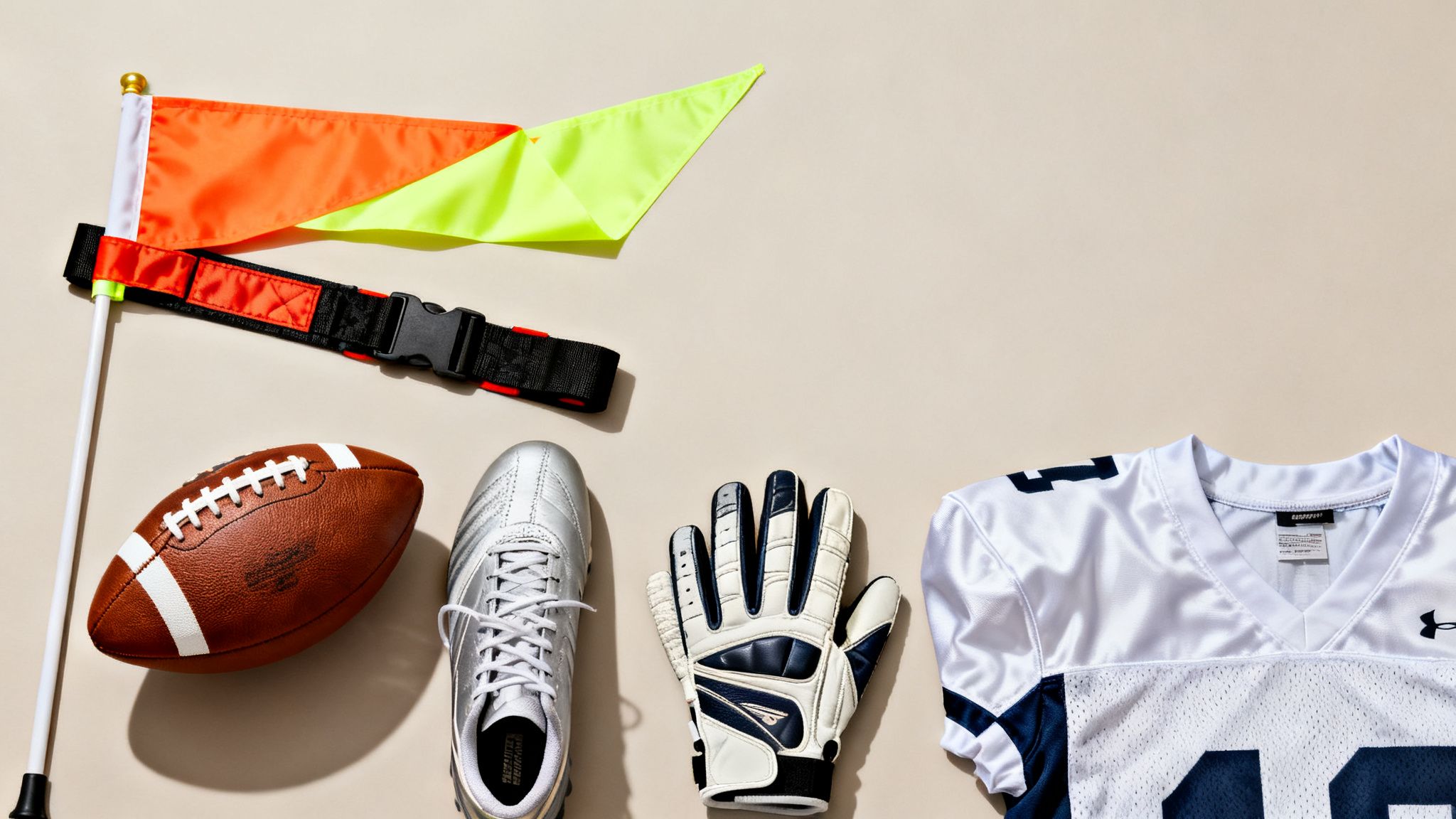
- Flag Belt and Flags: This is the heart and soul of the game. Most leagues use a belt with two or three flags that clip on or attach with Velcro. A good set is one where the flags pull off cleanly when grabbed but won't fall off while you're sprinting down the sideline.
- A Good Football: The ball size changes depending on your league—youth, adult, and coed leagues all have different standards. Make sure you've got a ball that meets your league's rules and has a solid grip for any weather.
You'll also need a team jersey, but that's usually handled by your league. Now, let's dive into the equipment that will really step up your game.
Gear That Gives You an Edge
Once you've got the basics covered, a few extra pieces can seriously boost your performance. This is the stuff designed to make you more agile, give you better control, and keep you comfortable so you can focus on making plays.
To make it simple, here's a quick rundown of the gear that can take your game from good to great.
Essential Flag Football Gear Checklist
| Gear Item | Purpose | Recommended Feature |
|---|---|---|
| Cleats | Provides critical traction for cuts, sprints, and stops. | Molded football or soccer cleats for grip on grass/turf. |
| Receiver Gloves | Improves grip for catching the ball, especially in wet weather. | Tacky palm surface for enhanced catching ability. |
| Mouthguard | Protects teeth and jaw from accidental impacts. | A comfortable, custom-fit model is best. |
| Performance Apparel | Keeps you cool, dry, and comfortable during play. | Moisture-wicking shorts, shirts, and compression gear. |
These items aren't just accessories; they are functional tools that directly impact how you play. Let's break down why each one is so important.
A Closer Look at Performance Gear
Cleats for Unbeatable Traction Your connection to the ground is everything in this game. Regular sneakers just won't do it when you need to make those explosive cuts and sudden changes of direction. Molded football or soccer cleats are your best friends here, giving you the grip you need to accelerate, stop on a dime, and pivot without losing your footing.
Your footwear is your foundation. The right cleats let you turn your raw athletic ability into on-field action, giving you the confidence to plant your foot and go.
Receiver Gloves for a Secure Grip A dropped pass can kill a drive. Receiver gloves, with their sticky palm surfaces, drastically improve your ability to reel in the football, especially when it's cold or wet. They provide that extra bit of confidence to snatch a ball that might have otherwise slipped right through your fingers.
Mouthguard for Essential Protection Even though this is a non-contact sport, accidents happen. Players bump into each other, and tumbles are inevitable. A mouthguard is a cheap and simple piece of gear that offers serious protection for your teeth and jaw from those unexpected hits.
Performance Apparel for Comfort You're going to be running hard and sweating a ton. Breathable, moisture-wicking clothes like performance shorts and compression gear are a must. They pull sweat away from your body, keeping you cool, dry, and comfortable, which helps you stay at the top of your game from the first whistle to the last.
For a great breakdown of what to look for, check out this guide on essential flag football equipment for youth. The tips in there are solid for players of all ages
Actionable Drills to Elevate Your Game
Raw talent is a great place to start, but flag football champions are made through smart, consistent practice. True skill comes from repetition—drilling moves until they become pure muscle memory. Think of this section as your personal toolkit, packed with drills to sharpen every part of your game, whether you're working solo or with the squad.
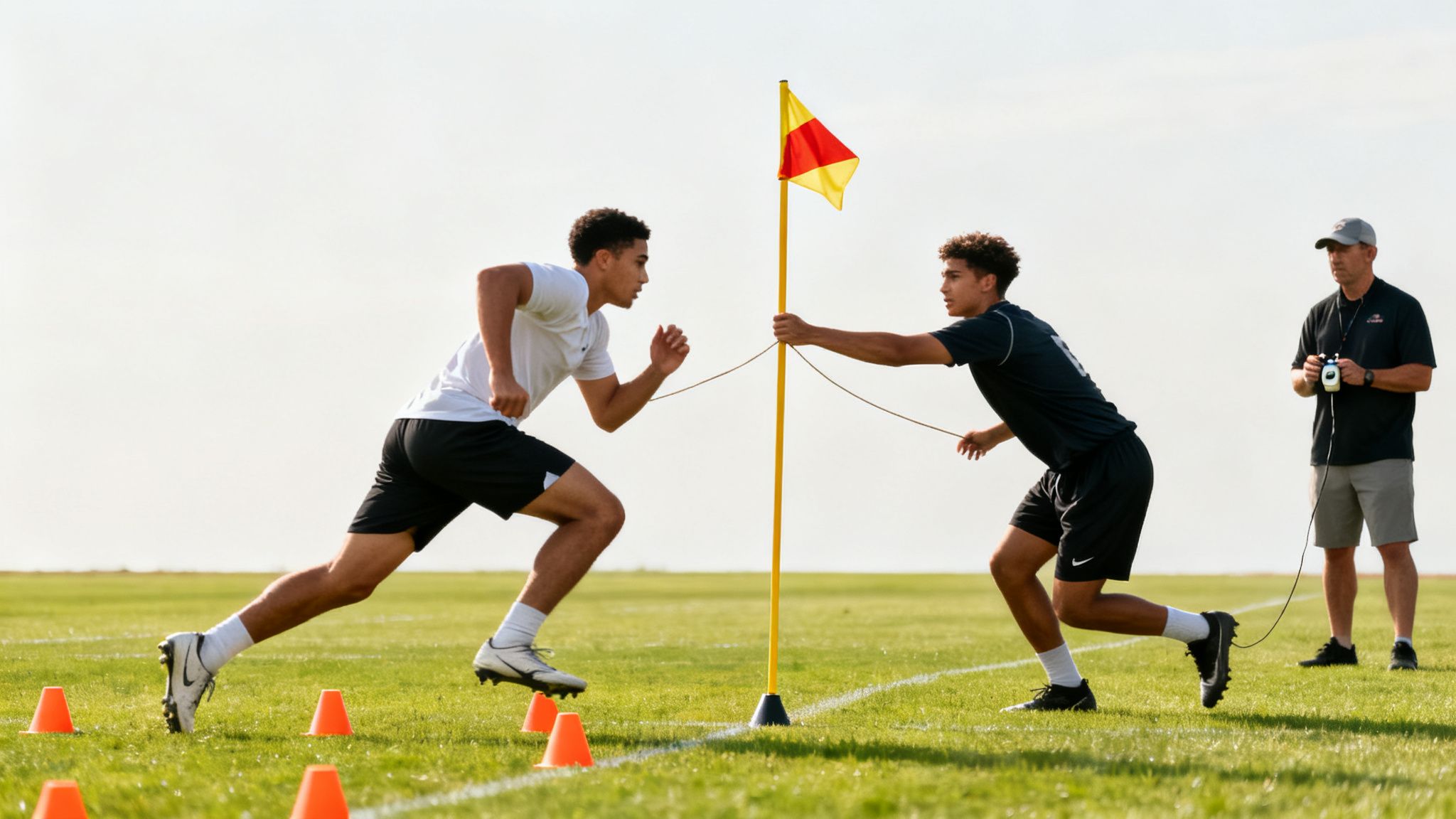
When you weave these exercises into your training, you're not just practicing—you're building the confidence and reflexes to make game-changing plays when it counts. Let's get to it.
Sharpening Your Defensive Agility
Defense is all about controlled aggression and seeing the play before it happens. A single, clean flag pull can completely shut down a scoring drive, and it all begins with your footwork. These drills are designed to boost your lateral speed and your ability to hunt down a ball carrier.
-
Circle the Cone Drill: Drop a cone on the ground and have a teammate run in a circle around it. Your job is to mirror their every move, staying low with your hips square to them. The goal is simple: stay close enough to pull the flag. This drill is perfect for teaching you how to stay balanced while shadowing a shifty runner.
-
Angle of Pursuit Drill: A ball carrier starts on one sideline and sprints for the opposite corner of the end zone. You, the defender, start about 10 yards away in the middle of the field. Your job is to take the perfect angle to cut them off and snatch the flag before they score. This is a must-have drill for understanding how to close the distance in the open field.
Perfecting Your Passing and Catching
A reliable air attack is the heartbeat of any good flag football offense. These drills will help quarterbacks dial in their accuracy and receivers build those trustworthy hands.
A successful pass isn't just a throw and a catch. It's a partnership built on timing and trust. The QB has to trust the receiver to be in the right spot, and the receiver has to trust the ball will be there. That connection is only built through practice.
For Quarterbacks You'll want to focus on drills that mimic game-day pressure and reward pinpoint precision.
- Pocket Presence Drill: Set up three cones in a tight triangle to create a makeshift pocket. Practice your drop-back, then step up or slide within that tiny space, all while keeping your eyes locked downfield. This teaches you how to feel comfortable moving your feet while you read the defense.
- Accuracy Net Drill: Use a throwing net or set up different targets at short, medium, and deep ranges. Work through your progressions, hitting each target in sequence to build both your accuracy and your arm strength for different types of throws.
For Receivers Great hands are built, not born. It all comes down to the fundamentals.
- Tennis Ball Toss: Have a partner toss tennis balls to you from a short distance. The smaller target forces you to really focus on tracking the ball with your eyes and catching it with your hands, not letting it hit your body.
- Distraction Catching: As you run your route, have a coach or teammate stand near the catch point and wave their hands or a blocking pad. This drill trains you to maintain intense focus on the ball and secure it, even with chaos in your peripheral vision—just like on a crowded field.
Answering Your Flag Football Questions
Got questions about flag football? You're not alone. Whether you're a curious parent or a potential player, it's smart to get a handle on the basics before you hit the field.
We've gathered some of the most common questions we hear. Let's clear them up so you can get out there and play with confidence.
What’s the Biggest Difference Between Flag and Tackle Football?
The single biggest difference is pretty straightforward: there’s no tackling. Instead of driving a player to the ground, a defender pulls a flag off the ball carrier's belt to stop the play. Simple.
But that one change completely reshapes the game. It shifts the entire focus from brute force to strategy and skill. You'll see different blocking rules and "no-run zones" near the end zone, which force teams to get creative with their passing game.
It’s a game of finesse over force. Winning in flag football is less about overpowering your opponent and more about outsmarting them with speed, agility, and precise plays.
Is Flag Football a Good Sport for Kids?
Absolutely. In fact, it’s one of the best ways to introduce kids to the fundamentals of football in a safe, positive environment. They learn all the key skills—passing, catching, running routes, and playing defense—without the high risk of injury that comes with tackle football.
Beyond the X's and O's, kids pick up valuable life skills. They learn how to communicate, work as a team, and handle wins and losses with good sportsmanship. It’s an ideal starting point for any young athlete.
How Can I Find a Flag Football League Near Me?
Finding a local league is easier than you might think. A few good places to start your search are:
- Your Local Parks and Rec: Check your city’s parks and recreation department website. They almost always organize or host sports leagues for all age groups.
- National Programs: Big organizations like NFL FLAG have easy-to-use online league finders. Just pop in your zip code and see what’s nearby.
- Social Media: Hop on Facebook and search for local sports groups. You’ll often find teams looking for new players or people organizing pickup games.
What Basic Skills Should a Beginner Focus On?
If you're brand new, don't overwhelm yourself by trying to learn everything at once. Just focus on these 3 fundamentals, and you'll be making a real impact from day one.
- Catch with Your Hands: Keep your eyes on the ball and catch it with your hands, not your body. This one habit will prevent a ton of dropped passes.
- Pull Flags Cleanly: Good defense is all about good footwork. Watch a runner's hips—they'll tell you where they're going. This puts you in the perfect position to get a clean pull.
- Run Precise Routes: On offense, start by learning a couple of basic routes, like a slant or an "out." The key is making sharp, decisive cuts to create space between you and the defender.
Nail these basics, and you'll be a valuable player on any team, right from the get-go.
Ready to gear up and hit the field? L2N2 LLC offers a complete collection of performance apparel, from cleats and gloves to comfortable team wear, designed to help you play your best. Check out our Flag Football collection and find everything you need.