

Find Adult Flag Football Near Me and Join the Perfect League
Finding adult flag football near me isn't the needle-in-a-haystack search it used to be. Thanks to the sport's massive growth, you've got options. Your best bet is to start with specialized league finder apps, local social media groups, and your city's parks and recreation department. These are the direct lines to sign-up info, schedules, and the league organizers themselves.
Your Search for Local Flag Football Ends Here
Jumping into adult flag football is a killer way to stay active, meet some new people, and let that competitive side out to play. But just figuring out where to look can feel like a game in itself. Forget the endless, random searching. Here’s a clear playbook for finding the best leagues in your area, starting with the sharpest tools in the shed.
The great news? You're joining a community that's absolutely exploding. Flag football has seen a huge surge in the U.S., with participation hitting roughly 7.3 million people in 2023. More players mean more leagues, more teams, and more opportunities for someone just like you. For a deeper dive into these numbers, check out the latest trends on Statista.com.
Where to Begin Your League Search
Your first move should be hitting the digital platforms built specifically to connect players with local sports leagues. Think of these websites and apps as central hubs that pull together all the info you’d otherwise have to hunt down across the web. They save you a ton of time by letting you filter by location, skill level, and even the day of the week you want to play.
And don't sleep on the power of social media. Facebook Groups are a goldmine for finding an adult flag football near me. Just search for terms like "[Your City] Flag Football" or "Local Sports Leagues." You'll find groups where captains are constantly posting about needing free agents and where organizers announce upcoming seasons.
Top Platforms for Finding Local Adult Leagues
To kick off your search, here's a quick guide to some of the most effective online resources for sniffing out flag football leagues in your area.
| Platform / App | Best For | Key Feature |
|---|---|---|
| Meetup | Finding social or casual drop-in games | Event-based structure makes it easy to find single games. |
| LeagueApps | Discovering established, competitive leagues | Often used by larger organizations for registration and scheduling. |
| Facebook Groups | Connecting directly with local players and captains | Real-time posts about team openings and pickup games. |
These platforms are great, but there's one resource that's often overlooked.
The most reliable spot is often the most old-school: your local parks and recreation department. Their websites are treasure troves of community-based leagues that are usually more affordable and focused on sportsmanship and fun.
These city-run programs have been the backbone of community sports for decades. They might not have the flashy marketing of some private leagues, but they offer consistency and a welcoming vibe that's perfect for both brand-new players and seasoned vets.
For a look at what some of the bigger, more established organizations look like, you can also explore our highlights of key flag football leagues in the U.S.. At the end of the day, a mix of digital searching and checking out these tried-and-true local options will give you the full picture of what’s out there.
How to Choose the Right League for Your Skill Level
Finding a few potential leagues is a great start, but picking the right one is the play that makes or breaks your season. Not all leagues are created equal, and your enjoyment really hinges on finding a good match for your skill and what you want to get out of the game.
It all starts with being honest with yourself. Are you looking for a hyper-competitive environment with cash prizes and a bunch of former college athletes? Or is a relaxed, co-ed weekend league more your speed? One isn't better than the other, but showing up to a laid-back game with intense ambition (or vice versa) is a recipe for a frustrating season.
Decoding League Competition Levels
Most leagues do a decent job of defining their divisions, but the labels can sometimes be a bit vague. Don't just rely on a name like "Intermediate." You've got to be a detective—look for clues in the league's description, check out photos from past seasons, and definitely read the rulebook to understand the true vibe.
Here are the common tiers you'll run into when you're searching for adult flag football near me:
- Social/Recreational: This is the perfect spot for beginners or anyone who just wants a fun run on a Sunday. The whole point is having a good time, running basic plays, and meeting new people.
- Intermediate: This is a clear step up. Players here usually have some experience, understand route concepts, and play with a bit more structure. The competition is real, but good sportsmanship is still the top priority.
- Competitive/Elite: These leagues are for the serious players. You can expect complex playbooks, high-speed gameplay, and teams that actually practice outside of game days. Often, there are cash prizes on the line.
This visual guide can help you map out your decision-making process, from your initial search all the way to finding the right competitive fit for you.
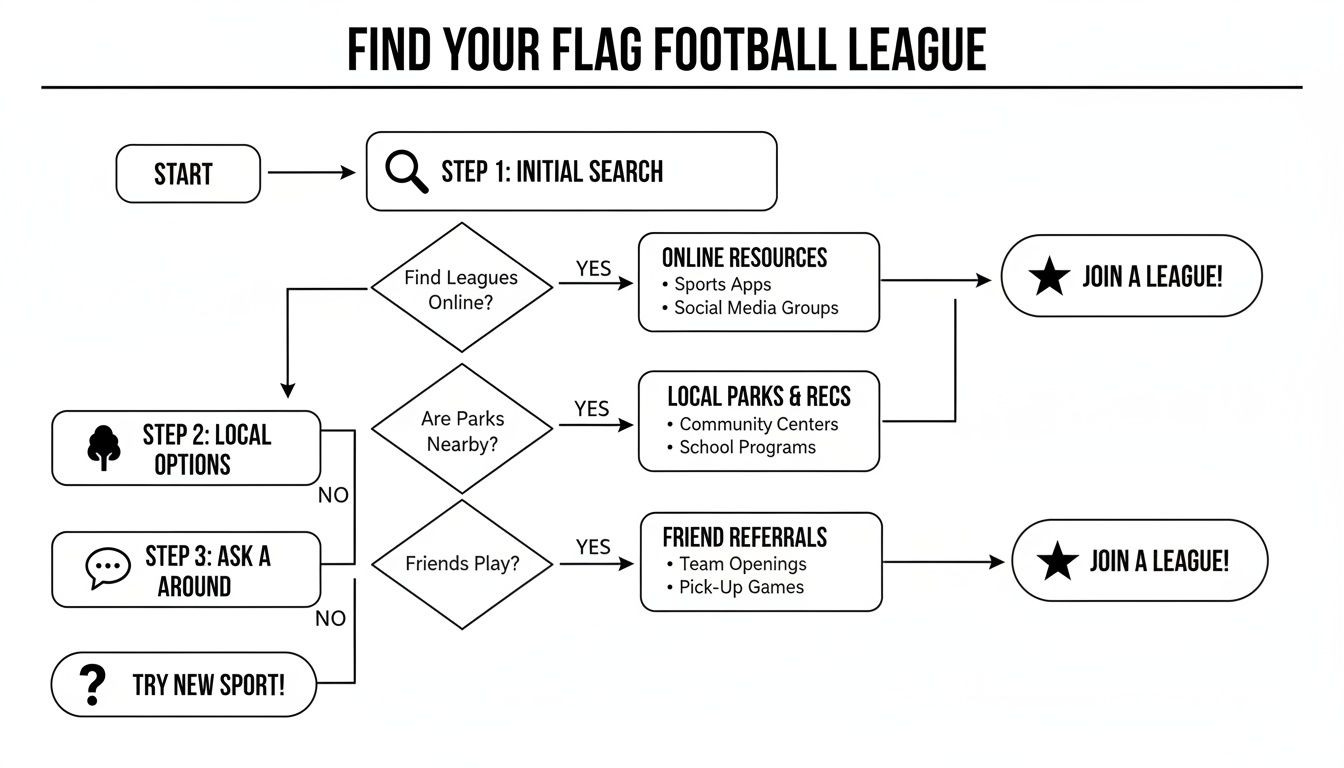
As you can see, both online and local searches all funnel into that crucial step of evaluating a league's style and rules.
Understanding the Costs and Rules
Once you've got a handle on the competitive level, it's time to dig into the practical details. League fees can vary wildly, so you need to know exactly what your money covers. A higher fee isn't necessarily a rip-off if it includes a full uniform, certified referees, and well-maintained fields.
Don't be afraid to ask the league commissioner for a full breakdown of the costs. A transparent league will gladly explain where your fees are going, from field permits and insurance to post-season awards.
Next, pay close attention to the rule set. The number of players on the field fundamentally changes the game. A 5v5 league is wide open and fast-paced, putting a premium on speed and agility. On the other hand, an 8v8 league plays much more like traditional football, with more blocking and complex offensive schemes. Neither is better, but they offer completely different experiences. For more on game formats, you might want to check out our general guide on the essentials of flag football.
Finally, look at the schedule. Does the league play on weeknights or weekends? Are the games always at the same time and place? Before you sign up, make sure the commitment fits your work and personal life. You don't want to be the teammate who can't make it to half the games.
From Free Agent to First String Player
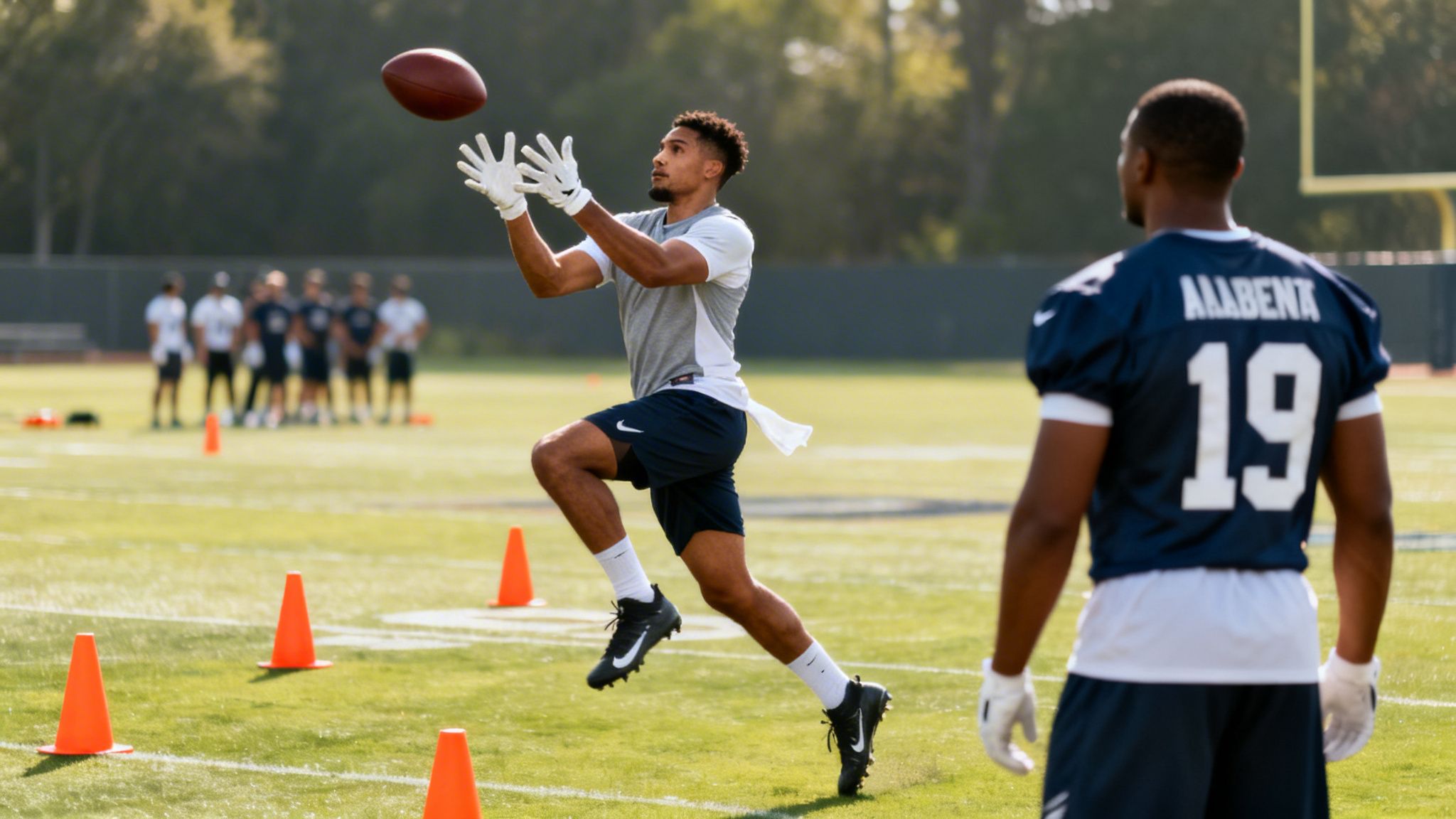
Okay, so you’ve found the perfect league. Now comes the real challenge: landing a spot on a team. It can feel a little daunting, especially if you’re signing up solo as a "free agent" instead of bringing a whole crew with you.
Most leagues run their sign-ups through an online portal. It's usually pretty straightforward—you'll fill out your contact info, maybe rate your skill level, and list your preferred positions. If you have a full team, the captain typically handles registration and payment for everyone. But if it's just you, you're essentially putting your name on a list for captains to scout.
And that's the catch. You can't just sit back and wait for the phone to ring. You have to be a little proactive to make sure you don't get lost in the shuffle.
Getting Noticed as a Free Agent
Just dropping your name onto a list and crossing your fingers is a recipe for watching the season from the sidelines. You’ve got to sell yourself a bit. Many leagues that welcome individual players searching for adult flag football near me will host a "free agent night" or some kind of open practice before the season kicks off.
You absolutely have to go to this. It's your single best opportunity to show what you can do in person, run a few drills, and, most importantly, actually talk to team captains. Honestly, a great attitude and hustling on every play will often get you picked faster than pure talent, especially in the more laid-back social leagues.
"I showed up to a free agent skate not knowing a soul. I just hustled on every drill and introduced myself to a few captains. I got three offers that night. Just showing up and trying hard is 90% of the battle." - Anonymous League Player
If the registration portal lets you create a player profile, do it. Keep it short and sweet. No one wants to read an essay, so use bullet points to make it easy to scan:
- Experience: "5+ years in recreational leagues."
- Primary Position: "Slot Receiver / Safety."
- Secondary Positions: "Willing to play Cornerback or rush the QB."
- Strengths: "Reliable hands, good field awareness."
A simple summary like that gives a busy captain all the info they need in a quick glance.
What to Expect During Tryouts
If the league runs more formal tryouts or evaluation days, expect to go through some basic football drills. Don't sweat it if you're a little rusty—the coaches are looking for potential and a good attitude just as much as raw skill.
You'll probably run through a few common exercises:
- 40-Yard Dash: A classic test for straight-line speed.
- Cone Drills: These are all about agility and how quickly you can change direction.
- Route Running: If you're a receiver, they'll want to see if you can run crisp routes like slants, outs, and posts.
- Catching/Throwing: Just the basics to see your hand-eye coordination and arm strength.
This whole process has gotten way more organized as the sport's popularity has exploded. Thanks to programs like NFL FLAG building a massive youth foundation, there are clearer pathways for adults to find well-run, organized leagues. You can actually read more about the booming growth of flag football from the NFL's official site.
Making a good first impression is simple. Show up early, bring your own water, wear cleats if you have them, and be vocal and positive with the coaches and other players. Your goal is to show everyone you're a reliable player who's ready to be a great teammate.
Gearing Up for Game Day Success
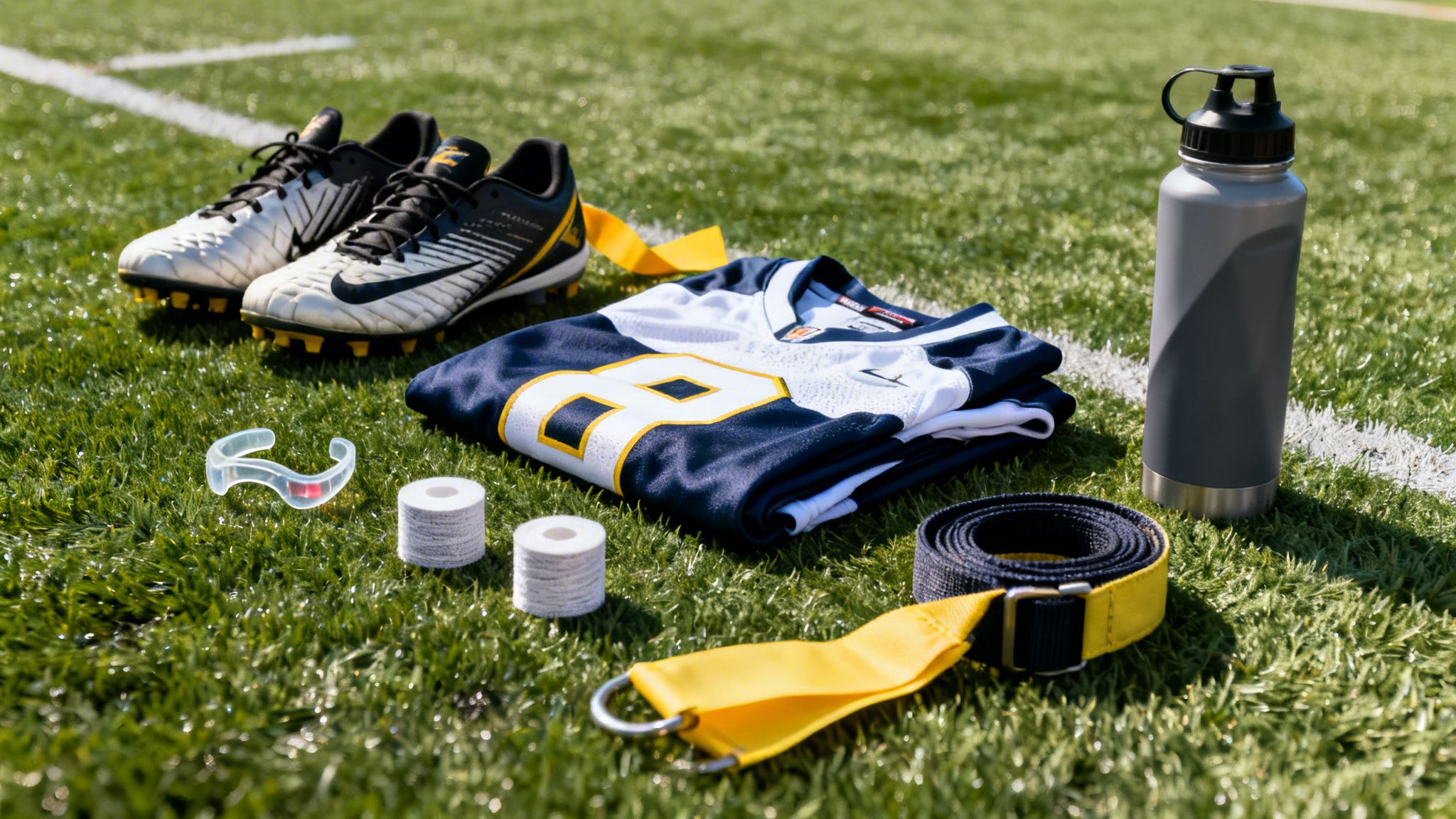
Showing up to the field ready to play is about more than just a mental boost—it’s crucial for your performance and safety. While you can leave the heavy-duty pads and helmets at home, the right flag football gear makes a huge difference. Think of it as your game-day armor, built for speed and agility.
Your most important investment starts from the ground up: a solid pair of cleats. They give you the traction needed for those sharp cuts and explosive sprints that win games. You'll need to figure out if your league plays mostly on turf or natural grass, as that determines whether you need molded plastic cleats or longer studs. Always check first.
Beyond that, you’ll need comfortable, durable athletic clothes. I always recommend moisture-wicking fabrics because they keep you dry and let you move freely. Your league might provide jerseys, but having your own go-to shorts or athletic pants is a must.
Must-Have Performance and Safety Gear
Once your basic apparel is sorted, a few accessories can seriously elevate your game and help you avoid common injuries. This is the stuff that separates the casual players from the ones who come prepared to dominate.
- Receiver Gloves: An absolute game-changer if you plan on catching the ball. The tacky grip gives you a real advantage, especially when it's damp out. It's the difference between a dropped pass and a highlight-reel catch.
- Mouthguard: Don't even think about skipping this. Contact happens, whether it's an accidental elbow going up for a jump ball or a collision during a flag pull. A mouthguard is a cheap, simple way to protect your teeth.
- Flag Belt: The league will almost certainly provide these for games. But trust me, owning your own for practice helps you get used to the feel and how it sits on your hips.
Your gear isn't just about looking the part; it's about functional performance. The right equipment minimizes distractions and lets you focus completely on the play, from the snap to the whistle.
For a great example of gear that gives you an edge, check out something like the Phenom Elite VPS5 adult football gloves. That’s the kind of grip that can turn a 50/50 ball into a sure thing.
Flag Football Gear Checklist
Here’s a quick rundown of what you should have in your bag. Some items are non-negotiable, while others are great to have as you get more serious about the game.
| Gear Item | Priority | Key Features to Look For |
|---|---|---|
| Cleats | Essential | Molded for turf, screw-in for grass. Focus on ankle support & light weight. |
| Flag Belt | Essential | Pop-socket or clip style. Check league rules for requirements. |
| Athletic Shorts/Pants | Essential | Moisture-wicking fabric, no pockets (often a league rule for safety). |
| Mouthguard | Essential | Custom-molded for best fit and protection. Don't go cheap here. |
| Receiver Gloves | Recommended | Tacky silicone palm for grip, breathable backhand material. |
| Athletic Socks | Recommended | Padded, moisture-wicking. Avoid cotton to prevent blisters. |
| Water Bottle | Essential | Insulated to keep water cold. Hydration is key. |
| Gear Bag | Optional | Vented compartments for cleats to air out. |
Having the right stuff in your bag means you can show up and just focus on playing your best football.
Uniforms and Team Coordination
Team captains, this one's for you. Getting your team's uniforms sorted out builds a real sense of identity, but you need to start early to avoid a last-minute scramble.
First, come up with a simple design and get everyone to agree on the colors. Then, collect sizes and—this is important—collect the money upfront. It makes the whole ordering process way smoother.
Lots of local print shops and online companies like L2N2 offer custom printing for team jerseys. It’s an awesome way to add your team name, logos, and player numbers for a more professional look on the field. Give your team a hard deadline and a direct link to order, and you'll be all set for opening day.
Making an Impact in Your First Season
Alright, you made it. You got through tryouts, paid the league fees, and now you’ve officially got a spot on the team. Congrats! This is where the real fun starts.
Now, making a real contribution in your first season isn’t about making flashy, highlight-reel plays every down. It’s about becoming a reliable, coachable, and positive force on the team. The learning curve can feel steep, but if you approach it the right way, you’ll get up to speed in no time.
The first hurdle is always the playbook. Don't just glance at the route tree and think you've got it. Actually visualize yourself running each pattern. Start connecting the play names to the concepts. For instance, if a play called "Flood" means a deep, intermediate, and short route all hit the same side of the field, picture how those routes work together to stretch out the defense.
Integrating with Your Team
Beyond the X's and O's, communication is what truly separates the good teams from the great ones. On the field, that means being loud and clear. Yell out the down and distance. Echo the quarterback’s signals. Talk to your fellow defensive backs about coverage adjustments. This constant chatter is what keeps everyone locked in and on the same page.
Off the field, make a genuine effort to connect. Learn your teammates' names and a little bit about what they do outside of football. That camaraderie is what builds the trust you need to pull through in those clutch moments. You're not just joining a team; you're joining a massive global community. The sport is blowing up, which is a big reason you could find an adult flag football near me to begin with.
Globally, flag football is experiencing an incredible surge, with over 20 million people now participating worldwide. The International Federation of American Football (IFAF) is overseeing the sport's development across 75 national member federations, a testament to its massive reach. You can find more details on flag football's worldwide growth on packedhousesports.com.
This worldwide momentum is why you’re seeing such well-organized and competitive local leagues popping up everywhere.
Being a Valuable Team Player
Your value as a rookie goes way beyond your athletic talent. Here are a few dead-simple ways to make a positive impact right from day one:
- Show Up Early: Get to the field at least 15-20 minutes before game time to warm up properly. It shows you’re committed and helps you stay injury-free.
- Know Multiple Positions: Don't be afraid to learn roles you don’t normally play. A player who can step in at cornerback or rush the passer when needed is absolutely invaluable.
- Stay Positive on the Sidelines: Your job doesn't stop when you're off the field. Encourage your teammates, especially after a tough play. A good attitude is contagious and keeps morale from dipping.
- Ask Smart Questions: If you’re confused about a play or a defensive scheme, pull your captain or a veteran player aside and ask. It’s always better to clarify than to make a mistake when it counts.
Ultimately, the goal is to be someone your team can depend on. Focus on solid communication, good preparation, and a great attitude. If you do that, you won't just contribute to your team's success—you'll have an incredible first season. And if you're looking to sharpen your raw athletic skills, our guide on how to train for peak performance is a great place to start.
Common Questions About Joining a Flag Football League
So, you've scouted some leagues and started thinking about gear. Awesome. But it's totally normal to still have a few questions buzzing around in your head before you're ready to pull the trigger and sign up.
Let's clear the air on some of the most common things new players wonder about when they’re looking to join an adult flag football near me. Getting these answers sorted can be the final push you need to get off the sidelines and into the game.
What Is the Average Cost to Join a League?
This is a big one, and the answer really depends on where you live and the type of league you're joining. Generally, you can expect to pay anywhere from $75 to $150 per player for a full season.
Here’s a rough breakdown of what that gets you:
- Lower-End Fees ($75-$100): This usually covers the bare essentials, like renting the fields and paying the refs. You'll likely have to buy your own jersey. City-run parks and rec leagues are a great example and almost always fall in this price range.
- Higher-End Fees ($120-$150+): When you pay a bit more, you’re usually getting a more complete package. This often includes a full team uniform (jersey and sometimes shorts), league insurance, and access to better facilities. Leagues with bigger prizes or more competitive divisions will also land on the higher end.
My advice? Always ask for a clear breakdown of what your registration fee covers. It prevents any weird surprises later on.
What If I Am a Complete Beginner?
Jumping into a new sport can feel a little intimidating if you've never played before. But here's the good news: tons of flag football leagues are built specifically for people just like you. The trick is to look for leagues or divisions labeled as "Social," "Recreational," or "Beginner."
These leagues are all about having a good time and learning the game, not about winning at all costs. You'll find that team captains and other players are usually super welcoming and more than happy to show you the ropes.
"We try to make it all inclusive and fun and work on team-building skills," says Collin Perry, a league promoter. That's the vibe in most rec leagues—it's about getting active and meeting people.
Seriously, don't let a lack of experience stop you. Everyone was a beginner at some point. A social league is the perfect, low-pressure spot to learn, build some confidence, and maybe even find your new favorite hobby.
How Much of a Time Commitment Is Required?
One of the best things about adult flag football is that it's designed for people with busy lives. The time commitment is almost always very manageable.
For a typical season, you're looking at:
- One game a week. It’s almost always on a consistent day, like every Sunday morning or a specific weeknight, so it’s easy to plan around.
- Games last about an hour. Most leagues run two 20- or 25-minute halves with a running clock to keep things moving.
- Practices are usually optional. In social leagues, practices are pretty rare. You might have them once a week in the more competitive divisions, but it’s not the norm for most players.
All in, you’re committing maybe two hours a week. It’s a super accessible way to stay active without completely taking over your schedule.
Ready to gear up and hit the field? L2N2 LLC has everything you need, from performance-minded apparel to the essential accessories like gloves and cleats. We also specialize in custom printing for your entire team. Find everything you need to dominate your first season at https://l2n2.store.